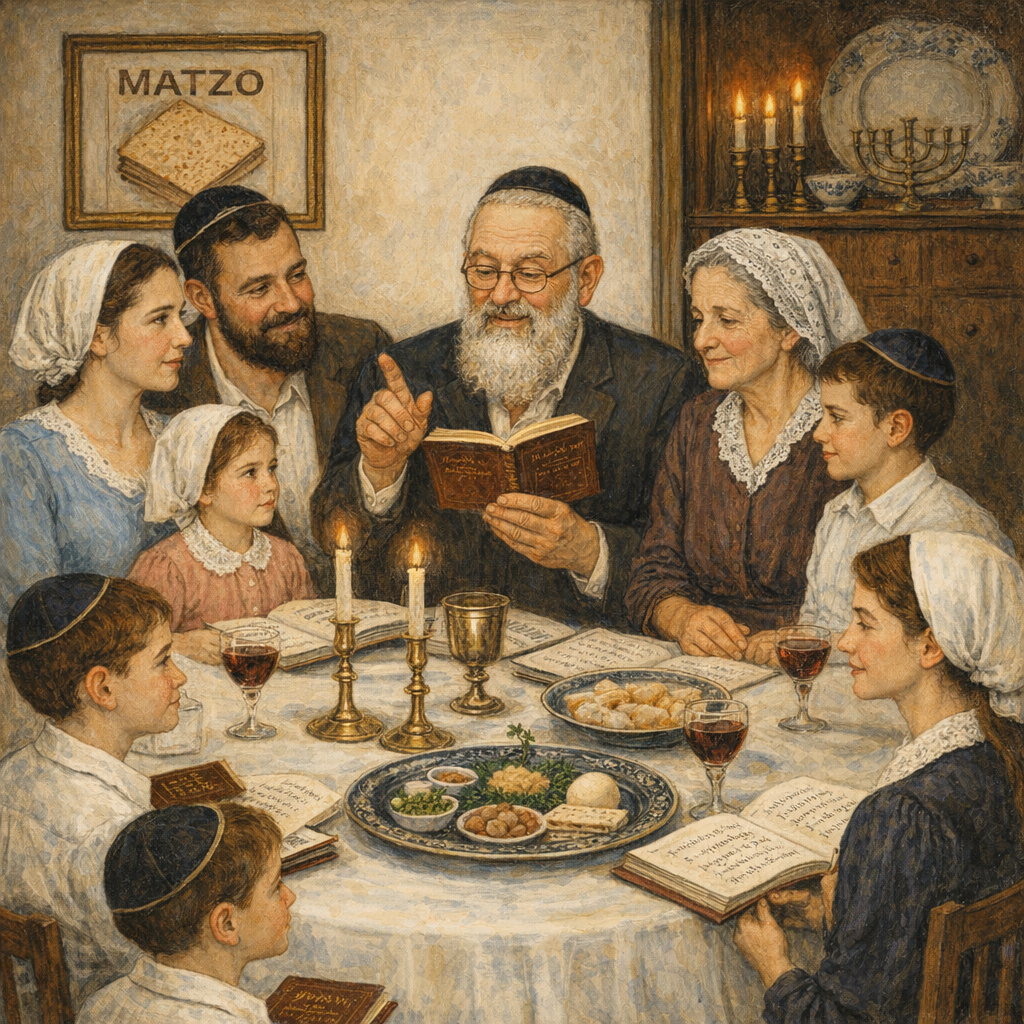
As Pesach approaches, I wanted to share a remarkable story that captures the resilience of the Jewish spirit — a story that reminds us what matzah, freedom, and Jewish identity have meant to our people across generations.
The Seder night mitzva of “Vehigadeta lebincha” commands us to relay our steadfastness to these Mitzvot to our youngsters. This moving story will serve as a beautiful addition as you perform this mitzvah at your own Seder.
Print it out, place it in your Haggadah, and enrich your family’s Seder experience.
Secret Sparks in Siberia
During the dark days of the Soviet regime, religious Jews in Russia lived under constant threat.
Arrested for “crimes against the state” – wearing tefillin and keeping Shabbat – the legendary Rav Yitzchok Silber had been sent to a brutal Siberian labor camp filled with genuine criminals.
Shortly after Purim, during one of his wife’s rare visits, Rav Yitzchok shared a worry that had been gnawing at him.
“Gita, my dear… what will I do for matzos?”
His wife swallowed hard. Her eyes darted past Rav Yitzchok to the nearby figure of Mishke, one of the camp’s most frightening prisoners – a hardened criminal and gang leader. Knowing full well that heartless thugs like him would jump at the chance to tattle on other prisoners, she waited until he drifted away before answering her husband.
“If they catch me bringing you matzos, I’ll be arrested as well,” she whispered.
“You’re right,” he said quietly. “But without matzos, without our precious mitzvos… what is life worth?”
Gita nodded. She knew what the mitzvah of Pesach meant to her husband. Steeling herself, she told him she was ready to risk everything.
Somehow, she managed to acquire twelve kilograms of flour. Late at night, after putting the children to sleep, she slipped away to a nondescript hiding spot, set up a makeshift oven, and started to bake.
Soon, twelve kilo of matzos were cooling around her. She piled them onto a sledge, covered them with a large blanket, and began pulling them home through the snow.
She was minutes from her apartment when she heard a harsh voice call, “Halt!”
Heart hammering, she turned slowly around. A policeman was striding across the road.
“What do you have there?” he demanded, pulling the blanket off her precious pile of contraband.
“Sir… just some crackers for my family,” she answered, trying to keep her voice steady.
“So many crackers for one small family?” He narrowed suspicious eyes. “Wait here. Don’t move.”
Gita whispered a prayer as the policeman strode away. A moment later, he returned, accompanied by a higher-ranking officer.
The officer glanced over Gita’s load in silence. Then he turned to the other policeman.
“It’s nothing. Let her go,” he said.
Trembling with relief, Gita hurried on her way, certain she had just encountered Eliyahu Hanavi.
Once home, she faced another challenge: How could she smuggle the matzos into her husband’s labor camp?
After some thought, she broke them into small pieces and packed them into boxes. Then she inked the words “Healthy tea crackers and jam for Yitzchok Silber” onto the top flaps of each one.
The smuggling was accomplished successfully. But Rav Yitzchok’s struggles weren’t over. If one of the camp guards discovered the real nature of his “crackers,” he would be punished severely. And that wasn’t all. In the labor camp, extra food was a magnet for thieves. How would he keep his matzos safe from plundering hands?
As he furtively opened one of his boxes, Mishke, the notorious prison gang leader, happened to glance his way.
“What do you have there?” he barked, lumbering over.
“Crackers.” Aiming for a casual tone, Rav Yitzchak held out the labeled box. “My wife visited and brought them from home.”
Mishke grabbed the box and peered inside. “Those aren’t crackers,” he scoffed. “That’s matzah!”
Rav Yitzchok froze. How did this coarse criminal know what matzah was? And what would happen to his precious “crackers” now?
Mishke handed the box back to him and cleared his throat. His tone was almost civil as he said, “Tell me. When is Seder night?”
Rav Yitzchok had to catch himself from sinking down in shock. Mishke? A Jew?
Before he could verbalize his question, Mishke turned to face the rest of the barrack.
“Anyone who dares touch Silver’s crackers will lose his head!” he bellowed.
And so the matzos were protected.
When Seder night arrived, Rav Yitzchok recited the Haggadah by heart. Mishke sat beside him, humming the tunes he remembered along with ten other members of his gang.
As they crunched the matzah and sipped a little grape juice they’d scavenged, these twelve lost Jewish souls spoke about the freedom they longed for. Freedom of body – and the freedom to live more fully as Jews.
___________________________________________
The Jewish story has always been one of extraordinary resilience. Even in the harshest places – a Siberian labor camp surrounded by danger and darkness – one Jew refused to give up on the mitzvah of matzah. And because of his courage, thirteen forgotten Jewish souls drew closer to their heritage.
The spark in the Jewish heart never disappears.
This is our mission at Belev Echad Le’Achdut. Reviving that spark. Helping forty-three “forgotten” Jewish communities across Israel reconnect to their heritage. Bringing people together around Torah learning and shared Jewish life.
Thank you for being our partners in fanning the flames of so many Jewish souls. Your support strengthens Jewish unity and connection every day.
Wishing you and your family a Chag Kasher V’Sameach — a Pesach filled with meaning, freedom, and joy.
Warmly,